Condition guide
Plantar Fasciitis Treatment in Sterling, VA
Personalized Physical Therapy to Reduce Heel Pain, Improve Foot Function, and Help You Walk Comfortably Again
That sharp pain in your heel when you first get out of bed can be more than just ordinary foot soreness.
Care centered on your life
If you have plantar fasciitis, you may experience a stabbing or aching sensation underneath your heel, particularly during the first few steps after waking up. The pain may ease somewhat as you begin moving, only to return later after prolonged standing, walking, exercise, or other activities.
For some people, plantar fasciitis begins after suddenly increasing their walking or running. For others, it develops gradually after spending long hours on their feet at work. It can also occur in people who are not athletes and who have never participated in high-impact exercise.
Over time, persistent heel pain can begin changing the way you walk. You may unconsciously avoid putting weight on the painful foot, shorten your stride, stop exercising, avoid going for walks, or become increasingly cautious about standing and moving.
Plantar fasciitis is one of the most common causes of pain underneath the heel. It involves the plantar fascia, a strong band of connective tissue that runs along the bottom of the foot and helps support the arch. Repeated loading and stress can irritate this tissue and cause pain, particularly where it attaches to the heel bone.
The good news is that most people with plantar fasciitis can be treated without surgery. Appropriate physical therapy can address the flexibility, strength, mobility, walking mechanics, activity levels, and other factors that may be contributing to your symptoms.
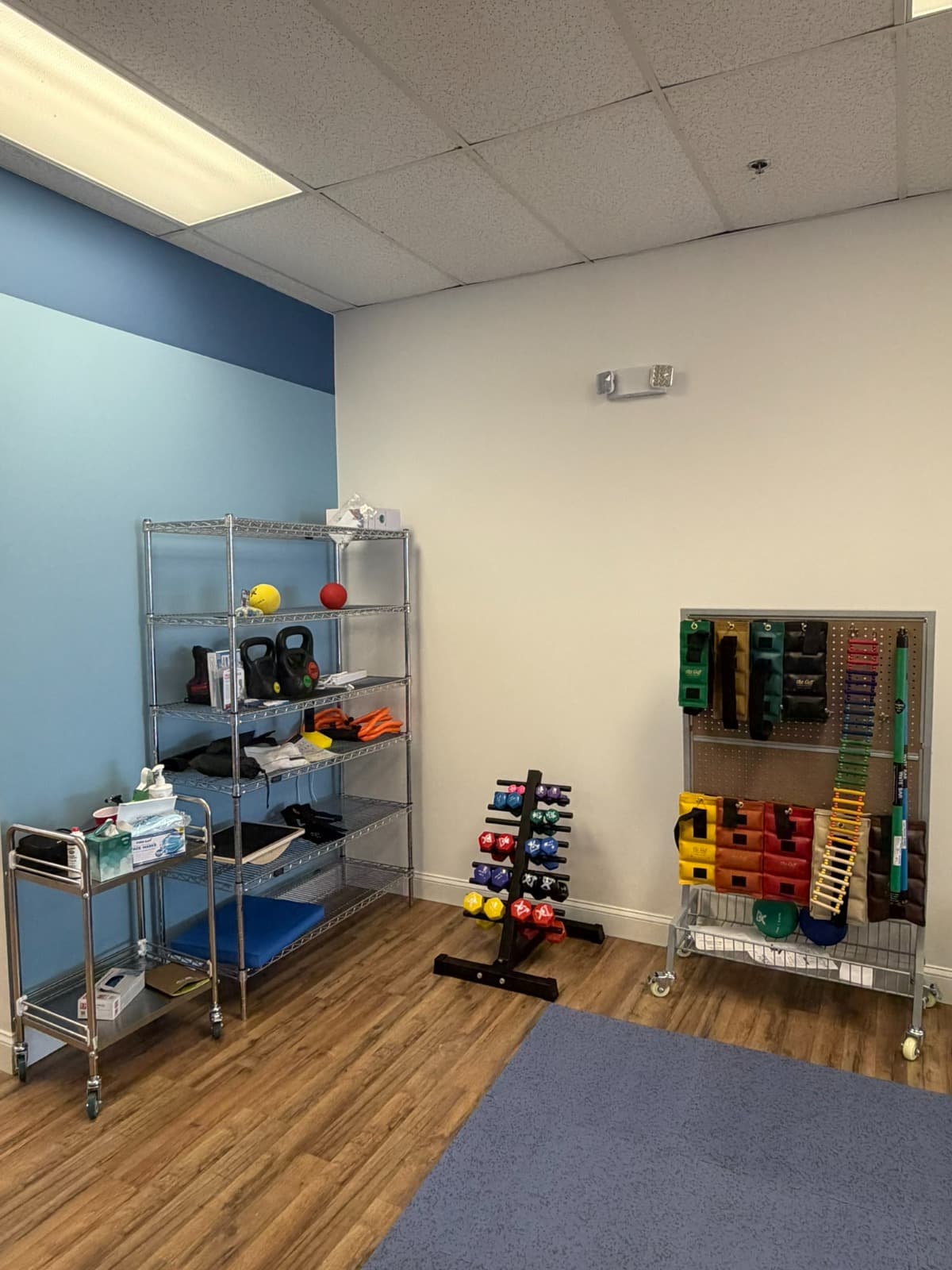
At 1st Americare Physical Therapy in Sterling, Virginia, our approach is centered around personalized rehabilitation designed to help patients improve mobility, strength, function, and confidence. The clinic currently describes its care model as emphasizing one-on-one attention, guided exercise, hands-on treatment, strengthening, balance training, and functional mobility care.
If you're experiencing persistent heel pain and are located in Sterling, Ashburn, Herndon, Reston, Leesburg, Potomac Falls, Cascades, Countryside, or nearby Northern Virginia communities, a physical therapy evaluation can help determine whether your symptoms are consistent with plantar fasciitis and whether rehabilitation is appropriate.
01 / Condition care
What Is Plantar Fasciitis?
Plantar fasciitis is a condition involving the plantar fascia, a thick band of connective tissue that extends along the bottom of your foot from the heel toward the toes.
The plantar fascia helps support the arch of your foot and contributes to the mechanics of walking. Every time you stand, walk, climb stairs, run, or push off the ground, the plantar fascia is involved in handling and transferring forces through your foot.
When the amount of stress repeatedly placed on the plantar fascia becomes greater than the tissue's ability to tolerate and adapt to that stress, pain can develop.
The condition is commonly associated with pain around the underside of the heel, although some people experience discomfort that extends toward the arch of the foot.
Plantar fasciitis can affect athletes and non-athletes alike. Someone who runs regularly may develop symptoms after increasing mileage, while someone who works in a restaurant may develop heel pain after spending long hours standing. A person who has recently started walking more for exercise may also experience symptoms if the increase in activity happens too quickly.
Plantar fasciitis is particularly common in adults, but it can occur across different age groups.
02 / Condition care
What Does the Plantar Fascia Do?
To understand plantar fasciitis, it helps to understand why the plantar fascia matters. Your foot needs to be flexible enough to adapt to the ground when you walk, but it also needs to become sufficiently stable to help you push off and move forward.
The plantar fascia contributes to this process by helping support the arch and assisting with the mechanical function of the foot during walking.
Every step places some degree of load through this structure.
Normally, your tissues are capable of handling this repeated loading. Problems may arise when the amount of loading increases suddenly, when the tissues are repeatedly exposed to more stress than they can currently tolerate, or when other factors such as reduced calf flexibility, foot mechanics, footwear, body weight, or prolonged standing contribute to increased demand. This is why plantar fasciitis is not necessarily caused by one single event.
03 / Condition care
Common Symptoms of Plantar Fasciitis
The most recognizable symptom of plantar fasciitis is pain underneath the heel, often near the area where the plantar fascia attaches to the heel bone.
One of the classic patterns is pain during the first few steps after getting out of bed in the morning. You may put your foot on the floor and immediately feel a sharp or stabbing sensation underneath your heel. After walking for a little while, the discomfort may decrease as the foot warms up and begins moving.
However, the pain may return after sitting for an extended period and then standing again. You may also notice discomfort after spending several hours on your feet, particularly if your work requires prolonged standing or walking.
Some people experience increased pain after running, jumping, climbing stairs, or other activities that place repeated load through the foot.
Walking barefoot, particularly on hard surfaces, may also aggravate symptoms in some people. Shoes with inadequate cushioning or support can make symptoms more noticeable.
As plantar fasciitis becomes more persistent, you may begin changing the way you walk to avoid pain. This can create additional stress on other parts of your foot, ankle, knee, hip, or back.
04 / Condition care
What Does Plantar Fasciitis Pain Feel Like?
Plantar fasciitis pain is often described as a sharp, stabbing pain underneath the heel, particularly when taking the first steps after a period of rest. Some people describe the sensation as a deep ache or tenderness rather than a sharp pain.
The location can also vary. While the heel is the most common location, discomfort may extend along the arch of the foot. A particularly important clue is the relationship between your pain and activity.
You may notice that the pain is worse when you first get up in the morning, improves somewhat after moving around, and then becomes worse again later in the day after prolonged standing or walking. That pattern is common with plantar fasciitis, but it is not enough by itself to establish a diagnosis. Other conditions can cause heel pain, which is why persistent or unusual symptoms deserve a proper evaluation.
05 / Condition care
What Causes Plantar Fasciitis?
Plantar fasciitis generally develops when repeated stress is placed on the plantar fascia. The tissue is designed to tolerate normal loading, but changes in activity, physical condition, foot mechanics, or daily demands can increase the stress placed on it.
One common trigger is a sudden increase in physical activity. For example, someone who normally walks only a few thousand steps per day may suddenly begin walking several miles every day. Someone may begin a new running program and increase mileage too quickly. Another person may start a physically demanding job that requires standing for eight or more hours a day.
In each situation, the foot may suddenly be required to handle a workload that is significantly greater than what it has been accustomed to. This does not necessarily mean that walking or exercise is harmful. Rather, the issue is often how quickly the workload increases compared with the body's ability to adapt.
06 / Condition care
Prolonged Standing and Walking
People whose occupations require them to spend much of the day on their feet may be more susceptible to plantar heel pain. This can include people working in:
- Healthcare
- Retail
- Restaurants
- Hospitality
- Manufacturing
- Warehouses
- Security
- Education
- Construction
- Other physically demanding occupations
Standing itself is not inherently harmful. However, standing for many hours without adequate opportunities to move, change positions, or recover can increase the cumulative load placed through the feet. If your heel pain is related to your occupation, treatment should take your actual work environment into account rather than simply telling you to “rest.”
07 / Condition care
Sudden Changes in Exercise
A sudden increase in running, walking, hiking, or other weight-bearing activity can increase stress on the plantar fascia. For example, you may develop heel pain after:
Starting a new running program.
Increasing your walking distance.
Beginning regular hiking.
Training for an event.
Returning to exercise after a long period of inactivity.
Changing from mostly sedentary activity to a highly active routine.
Your body needs time to adapt to new physical demands.
Gradually increasing activity allows the muscles, tendons, bones, joints, and connective tissues of the lower extremity to adjust to the workload.
08 / Condition care
Calf Tightness and Limited Ankle Mobility
The muscles at the back of your lower leg connect to the ankle and contribute to how your foot moves when you walk.
If the calf muscles and ankle have limited flexibility, the mechanics of walking may change, potentially increasing the demands placed on the plantar fascia.
This is one reason calf and ankle mobility are commonly evaluated during a plantar fasciitis assessment.
A physical therapist can determine whether limited ankle movement is actually present and whether improving mobility is appropriate for your particular situation.
09 / Condition care
Foot Structure and Mechanics
The structure and movement of your feet can also influence how forces are distributed during walking.
People with flat feet, high arches, or other variations in foot mechanics may experience different patterns of loading through the foot.
However, having flat feet or high arches does not automatically mean that you will develop plantar fasciitis.
Foot structure is only one factor among many. The more useful question is often:
How does your foot function during the activities that are causing your symptoms?
A physical therapist can evaluate your foot and ankle mechanics while you stand, walk, and perform functional movements.
10 / Condition care
Body Weight and Plantar Fasciitis
Body weight can influence the amount of force transmitted through the feet during weight-bearing activities. Higher body weight has been identified as one factor associated with plantar fasciitis. However, plantar fasciitis is not simply a weight-related condition. People at many different body weights can develop heel pain. A good rehabilitation plan should therefore focus on the individual's symptoms, activity demands, strength, mobility, physical conditioning, and goals rather than reducing the condition to a single risk factor.
11 / Condition care
Footwear and Plantar Fasciitis
Footwear can influence how your foot feels during walking and standing. Shoes with inadequate cushioning or support may aggravate symptoms in some people, particularly when combined with prolonged standing or walking.
You may notice that your heel hurts more when walking barefoot or wearing very thin, hard-soled shoes. Supportive footwear can sometimes reduce symptoms by changing how forces are distributed through the foot.
However, footwear alone does not necessarily address the underlying factors contributing to plantar fasciitis.
A physical therapist can help you determine whether footwear changes, temporary inserts, or other modifications may be useful as part of your overall rehabilitation program.
12 / Condition care
Is a Heel Spur the Same as Plantar Fasciitis?
No. This is an important distinction because many people believe that a heel spur is the cause of their heel pain.
A heel spur is a bony growth that can develop around the heel. Heel spurs can occur in people who have plantar fasciitis, but the presence of a spur does not automatically mean that it is the source of your pain. In fact, some people have heel spurs without experiencing any symptoms.
For this reason, finding a heel spur on an X-ray does not necessarily mean that the spur needs to be removed or that surgery is required. Your symptoms and physical examination are more important in determining what may be contributing to your pain.
13 / Condition care
How Is Plantar Fasciitis Diagnosed?
Plantar fasciitis is generally diagnosed through your medical and activity history and a physical examination. Your physical therapist may ask when your pain started, whether there was a change in your activity, what makes the pain better or worse, how much time you spend standing or walking, what type of footwear you normally wear, and whether you have experienced previous foot or ankle problems.
The therapist may then examine your foot, ankle, and lower leg. This may include evaluating your foot and arch position while standing, assessing your walking pattern, examining the heel and plantar fascia for tenderness, and checking ankle and calf flexibility.
Your therapist may also assess how your symptoms respond when the toes and ankle are moved into different positions.
The purpose of the examination is not only to determine whether plantar fasciitis is likely but also to make sure that another condition is not a better explanation for your symptoms.
14 / Condition care
Conditions That Can Cause Similar Heel Pain
Not every case of heel pain is plantar fasciitis. Other conditions can cause pain in or around the heel, including certain tendon problems, nerve-related conditions, stress injuries, joint problems, and other disorders affecting the foot and ankle.
This is particularly important if your symptoms do not follow the typical pattern of plantar fasciitis or if they are unusually severe. A thorough physical therapy evaluation can help determine whether your symptoms appear appropriate for conservative rehabilitation or whether you should be referred for further medical evaluation.
15 / Condition care
How Can Physical Therapy Help Plantar Fasciitis?
Physical therapy focuses on more than temporarily reducing heel pain. The larger objective is to help your foot and lower extremity tolerate the activities you need and want to perform.
At 1st Americare Physical Therapy, your treatment can be individualized according to your symptoms, physical abilities, activity demands, and goals.
Depending on your evaluation, rehabilitation may address the flexibility of your calf and foot, strength of the muscles supporting your foot and ankle, walking mechanics, activity levels, footwear, and other contributing factors.
A treatment plan may include therapeutic exercise, mobility work, strengthening, gait training, hands-on techniques when appropriate, activity modification, and a personalized home program. Physical therapy treatment for plantar fasciitis commonly incorporates stretching, strengthening, gait assessment, footwear or orthotic guidance, and other conservative approaches.
16 / Condition care
Stretching for Plantar Fasciitis
Stretching may be useful when limited flexibility in the calf, ankle, or plantar fascia is contributing to your symptoms. A physical therapist may prescribe specific stretches designed to improve the flexibility of the tissues involved in walking.
The goal is not to aggressively stretch a painful foot. Instead, stretching should be appropriately dosed and progressed according to your symptoms.
Your therapist may also teach you when to perform your stretches. For example, before getting out of bed, after prolonged sitting, before exercise, or after activity, depending on your individual presentation.
17 / Condition care
Strengthening for Plantar Fasciitis
The muscles of your foot and lower leg play an important role in supporting the foot during standing and walking. If these muscles are weak or have reduced endurance, your therapist may develop a strengthening program to improve their ability to tolerate activity.
Strengthening may involve the foot, ankle, calf, and other muscles of the lower extremity. The exercises may begin at a relatively simple level and gradually become more challenging.
As your strength improves, your therapist can progress the program so that your foot becomes better prepared for the activities you need to perform.
18 / Condition care
Improving Calf and Ankle Mobility
Your ankle needs enough mobility to allow your body to move smoothly over your foot during walking. If your ankle is stiff, you may compensate elsewhere in your lower extremity.
Your therapist can determine whether restricted ankle movement is contributing to your symptoms and, if so, incorporate appropriate mobility exercises into your rehabilitation. Improving mobility is not about forcing the ankle into extreme positions. It is about restoring the movement needed for normal function.
19 / Condition care
Gait and Walking Assessment
The way you walk can provide valuable information about what is happening in your foot. When you are experiencing heel pain, you may subconsciously change your walking pattern to avoid putting pressure on the painful area.
You may take shorter steps, spend less time on the affected foot, or shift your weight differently. These changes may temporarily reduce discomfort but can create additional stress elsewhere.
A physical therapist can observe your walking pattern and determine whether movement changes may be contributing to your symptoms.
If necessary, gait training can help you gradually return to a more comfortable and efficient walking pattern.
20 / Condition care
Manual Therapy
Depending on your individual examination, hands-on treatment may be incorporated into your rehabilitation. Manual therapy may be used to address restrictions in the foot, ankle, calf, or surrounding soft tissues and to help improve movement.
However, hands-on treatment is generally most useful when it is combined with active rehabilitation. The long-term objective is not for you to depend on someone repeatedly treating your foot.
It is to help you develop the mobility, strength, and capacity necessary to manage normal activities more independently.
21 / Condition care
Taping and Temporary Support
In some cases, your therapist may recommend taping techniques to provide short-term support or symptom relief. Taping can sometimes help you tolerate walking while you work on the underlying factors contributing to your symptoms.
However, taping is generally considered a temporary tool rather than the entire treatment. Your rehabilitation should continue toward improving your foot and lower-extremity capacity.
22 / Condition care
Footwear and Orthotics
Your physical therapist may discuss footwear if your current shoes appear to be contributing to your symptoms. Depending on your foot mechanics and activity demands, supportive shoes or shoe inserts may sometimes be useful.
Orthotics are not automatically necessary for everyone with plantar fasciitis. If an insert is recommended, it should be considered in the context of your overall treatment rather than as a replacement for strengthening and mobility work. Your therapist can help you determine whether additional foot support is appropriate.
23 / Condition care
Night Splints
Some people experience particularly severe morning heel pain because the plantar fascia and calf tissues become relatively less stretched while the foot is resting.
A night splint may be considered in certain cases to maintain the ankle and toes in a position that gently stretches the plantar fascia and calf while you sleep.
Night splints are not necessary for everyone. Whether one is appropriate depends on your symptoms, tolerance, and response to other treatments.
24 / Condition care
Activity Modification
One of the most important parts of plantar fasciitis rehabilitation is learning how to manage your activity without becoming completely inactive. If you suddenly increase your walking distance, for example, your therapist may recommend temporarily reducing the amount while maintaining other forms of movement that your foot can tolerate.
As symptoms improve and your strength increases, your activity can gradually progress again. This is particularly important for runners and people whose work requires prolonged standing because the goal is to find the level of activity that your foot can currently tolerate, then gradually build its capacity.
25 / Condition care
Returning to Exercise After Plantar Fasciitis
If you developed plantar fasciitis after starting or increasing exercise, you may be understandably concerned about returning to activity.
A gradual return is generally more appropriate than going from complete rest directly back to your previous workload.
Your therapist can help you determine how to progress walking, running, hiking, or other activities based on your symptoms and functional capacity.
For a runner, this may mean gradually increasing distance before increasing speed or intensity.
For someone who enjoys hiking, it may involve progressively increasing walking distance and terrain difficulty.
For someone who works on their feet, rehabilitation may focus on improving the endurance necessary to tolerate a full workday.
26 / Condition care
Can Physical Therapy Cure Plantar Fasciitis?
It is better to think about physical therapy as rehabilitation and recovery rather than a guaranteed cure.
Many cases of plantar fasciitis improve with conservative treatment over time, and surgery is rarely necessary.
However, recovery can take time. The goal of physical therapy is to help identify and address factors contributing to your symptoms while gradually restoring your ability to tolerate normal activity.
A successful outcome is not simply having less pain while sitting.
It is being able to walk, stand, exercise, work, travel and to basically enjoy your daily activities without your heel pain continually limiting you.
27 / Condition care
Can Plantar Fasciitis Come Back?
Yes, symptoms can recur. Recurrence may occur when activity increases faster than your foot's capacity to tolerate the new workload.
For example, you may feel much better after several weeks of rehabilitation and suddenly return to long-distance running or extensive walking.
Your foot may not yet be ready for that level of demand. This is why continuing an appropriate strengthening and mobility program, maintaining reasonable activity progression, and paying attention to early warning signs can be valuable. The goal is not to become afraid of activity. It is to make your foot more capable of handling activity.
28 / Condition care
When Should You See a Physical Therapist for Plantar Fasciitis?
You should consider a physical therapy evaluation if heel pain is beginning to interfere with your normal activities or is not improving as expected. This is particularly important if you have persistent morning heel pain, discomfort when standing or walking, pain that repeatedly returns after activity, or symptoms that are causing you to change the way you walk.
You may also benefit from an evaluation if you recently increased your walking or running, started a physically demanding job, or have been experiencing recurring heel pain despite changing your footwear or reducing activity. You do not necessarily need to wait until the pain becomes severe.
Early evaluation can help identify contributing factors and give you a structured plan for managing your symptoms.
29 / Condition care
What Happens During a Plantar Fasciitis Physical Therapy Evaluation?
Your first appointment should begin with a conversation about your symptoms and your life, and not simply an examination of your heel.
Your therapist may ask when the pain began, whether you recently changed your activity, how much time you spend standing or walking, what type of work you perform, what footwear you normally use, whether you exercise, and what activities you have stopped doing because of the pain.
The therapist may then examine your foot and ankle, assess the position of your arch, evaluate your walking pattern, check calf and ankle flexibility, assess strength, and examine the area around your heel and plantar fascia.
Your therapist may also look at how your entire lower extremity moves because the foot does not function independently.
The hip, knee, ankle, and foot all contribute to the way forces travel through the lower extremity.
The evaluation helps determine which factors are relevant to your symptoms and allows your treatment plan to be tailored accordingly.
30 / Condition care
When Should You Seek Immediate Medical Attention?
Most plantar fasciitis is not an emergency. However, not every type of heel or foot pain should be treated as routine plantar fasciitis. If your pain began after a significant accident, fall, or other trauma, you may need medical evaluation before beginning routine physical therapy. You should also seek prompt medical attention if you suddenly become unable to bear weight on the foot, develop significant swelling or deformity, or experience severe pain that is substantially different from your usual symptoms. A foot that becomes unusually red, hot, or swollen particularly if you also have a fever or feel generally unwell requires medical assessment because infection or another inflammatory condition may need to be ruled out.
Persistent numbness, significant weakness, or other unusual neurological symptoms should also be medically evaluated rather than automatically attributed to plantar fasciitis.
31 / Condition care
Plantar Fasciitis With Sudden Severe Pain
If you experience sudden, severe heel pain and cannot walk normally, particularly after an injury or sudden forceful movement, do not assume that you simply have plantar fasciitis.
A stress injury, fracture, tendon injury, or another condition may need to be ruled out.
A physical therapist can help determine whether your presentation is appropriate for physical therapy or whether medical imaging or another form of evaluation is necessary.
32 / Condition care
Why Choose 1st Americare Physical Therapy for Plantar Fasciitis?
Persistent heel pain can be frustrating because the problem may seem small while having a surprisingly large effect on your life.
You may be able to tolerate the pain when sitting, but walking to the grocery store, standing at work, exercising, or playing with your children may become increasingly difficult.
At 1st Americare Physical Therapy in Sterling, VA, the focus is on helping patients improve mobility, strength, function, and independence through personalized physical therapy care. The clinic currently describes its rehabilitation environment as patient-focused and emphasizes one-on-one attention, guided exercise, hands-on treatment, strengthening, balance training, and functional mobility.
33 / Condition care
One-on-One Attention With Your Physical Therapist
Plantar fasciitis is not exactly the same for every patient. One person's heel pain may be associated with a sudden increase in running. Another person's may be related to prolonged standing at work. Someone else may have limited ankle mobility and reduced lower-leg strength.
This is why individualized attention matters. Your physical therapist can observe how you stand, walk, balance, move your ankle, and perform exercises and can adjust your rehabilitation as your symptoms change.
34 / Condition care
A Treatment Plan Built Around Your Life
Your goal may not simply be to “get rid of heel pain.”
You may want to walk around the neighborhood again.
You may want to stand through an entire work shift.
You may want to return to running.
You may want to travel without worrying about every step.
You may want to play with your grandchildren.
You may simply want to get out of bed in the morning without that familiar stabbing pain.
Those goals should influence your rehabilitation.
At Americare, treatment can be structured around your individual functional needs rather than treating the foot in isolation.
35 / Condition care
Serving Sterling and Nearby Northern Virginia Communities
1st Americare Physical Therapy is located at 23520 Overland Dr #128, Sterling, VA 20166, and we identify ourselves as a leading Sterling physical therapy practice providing orthopedic, neurological, post-operative, vestibular, sports, pediatric, and geriatric rehabilitation clinic.
Patients searching for plantar fasciitis physical therapy in Sterling, VA may also come from nearby communities such as Ashburn, Herndon, Reston, Leesburg, Potomac Falls, Cascades, Countryside, and Dulles.
36 / Condition care
Frequently Asked Questions About Plantar Fasciitis
What is plantar fasciitis?
Plantar fasciitis is a painful condition involving the plantar fascia, a strong band of connective tissue that runs along the bottom of the foot and helps support the arch. It commonly causes pain around the underside of the heel and may become particularly noticeable during the first steps after waking or after prolonged inactivity.
Why does my heel hurt when I first get out of bed?
Morning heel pain is one of the classic patterns associated with plantar fasciitis. After your foot has been resting overnight, the first few steps can place tension through the plantar fascia and reproduce pain. Some people notice that the discomfort decreases after walking for a few minutes and then returns later after prolonged activity.
Can physical therapy help plantar fasciitis?
Yes. Physical therapy can address several factors that may contribute to plantar heel pain, including calf and ankle flexibility, foot and lower-extremity strength, walking mechanics, activity levels, and functional limitations. Treatment can include stretching, strengthening, gait assessment, activity modification, and other individualized interventions.
Do I need to stop walking if I have plantar fasciitis?
Not necessarily. Complete inactivity is not always required. In many cases, the better approach is to identify the amount of walking your foot can currently tolerate and gradually build your capacity. Your therapist can help you modify activity without unnecessarily eliminating movement.
Can I run if I have plantar fasciitis?
That depends on the severity of your symptoms and your current ability to tolerate running. If running is contributing to your pain, temporarily modifying your running volume or intensity may be appropriate while you build strength and capacity. A gradual return is generally preferable to suddenly returning to your previous mileage after a period of rest.
Is plantar fasciitis caused by flat feet?
Flat feet can be one factor associated with plantar fasciitis, but having flat feet does not mean that you will develop the condition. Foot shape is only one part of the larger picture. How your foot moves, how much activity you perform, your strength and mobility, footwear, and other factors can also influence symptoms.
Is a heel spur causing my plantar fasciitis?
Not necessarily. Heel spurs can occur in people who have plantar fasciitis, but the presence of a spur does not automatically mean that the spur is causing your pain. Some people have heel spurs without symptoms. Treatment therefore focuses on the patient's symptoms and functional limitations rather than automatically treating an X-ray finding.
Do I need orthotics for plantar fasciitis?
Not everyone needs orthotics. Supportive footwear or an insert may be helpful for some patients depending on their symptoms and foot mechanics, but an insert should generally be considered as one component of a broader treatment plan rather than the sole solution.
Can plantar fasciitis go away without surgery?
Yes. Most cases improve with conservative management, and surgery is rarely required. Recovery may involve activity modification, stretching, strengthening, appropriate footwear, and other individualized treatment.
How long does plantar fasciitis take to heal?
There is no single recovery timeline. Some people improve relatively quickly, while others experience symptoms for several months. Recovery depends on how long you have had symptoms, the factors contributing to the problem, your activity level, your physical capacity, and how your symptoms respond to treatment.
Can plantar fasciitis come back?
Yes. Symptoms can recur, particularly if activity increases rapidly or the factors contributing to the original problem are not addressed. Maintaining appropriate strength, gradually progressing activity, and responding early to recurring symptoms can help you manage your foot more effectively.
Should I stretch my plantar fascia?
Stretching may be helpful for some people, particularly when limited calf, ankle, or plantar-fascia flexibility contributes to symptoms. However, the type and amount of stretching should be appropriate for your condition. Aggressively stretching a painful tissue is not necessarily better.
What shoes are best for plantar fasciitis?
There is no single shoe that is best for everyone. Many people find that shoes with appropriate cushioning and support are more comfortable than very thin, hard-soled, or poorly supportive footwear. The right choice depends on your foot structure, activity, symptoms, and personal comfort.
Can plantar fasciitis cause pain in the arch?
Yes. Although the heel is the most common location, plantar fasciitis can cause tenderness or discomfort extending along the arch of the foot.
Why does my heel hurt after sitting?
Some people with plantar fasciitis experience pain when standing after sitting for a prolonged period. Similar to morning pain, the first few steps after inactivity can place tension through the plantar fascia and reproduce symptoms.
Ready to Get Started?
Schedule Your Plantar Fasciitis Physical Therapy Evaluation at 1st Americare Physical Therapy
Whether your heel pain developed after increasing your walking, starting a new exercise program, spending long hours on your feet, or gradually appeared over time, our team can evaluate your symptoms and help determine an appropriate next step.
1st Americare Physical Therapy 23520 Overland Dr #128 Sterling, VA 20166 Serving patients from Sterling and nearby communities, including Ashburn, Herndon, Reston, Leesburg, Potomac Falls, Cascades, Countryside, and Dulles.
Walk With Greater Comfort. Build Strength. Get Back to Your Life.
Contact 1st Americare Physical Therapy today to schedule your evaluation.
Medical disclaimer: This page provides general educational information and is not intended to diagnose or treat an individual condition or replace advice from a physician or other qualified healthcare professional. Heel pain can have many causes. Significant trauma, inability to bear weight, severe swelling, deformity, fever with a hot or red foot, sudden weakness or numbness, or other concerning symptoms require appropriate medical evaluation.
A personalized next step
Schedule a physical therapy evaluation.
Contact Americare Physical Therapy to discuss your symptoms and whether physical therapy may be appropriate for you.
Schedule an Evaluation